

Foodservice Looks Like It's Still in Value Mode. The 2026 Restaurant Show Showed That's Only Half the Story.
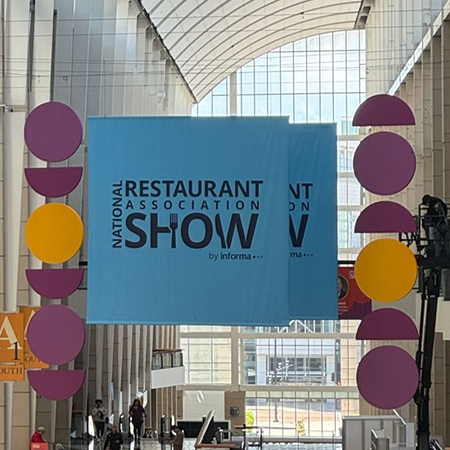
Walking the 2026 National Restaurant Show floor for the fifth year, the most telling signal was a quiet one. Over a hundred manufacturer booths present in 2025 were not on the floor this year, and the hall moved easily. The industry is still in cash-preservation mode.
Retail spent the last two years cycling back toward innovation. Foodservice has not. The consumer pressure behind that gap is where the read of the show begins, and the operators winning right now showed where it goes next.
The At-Home Shift Is Driving the Cycle
USDA Economic Research Service data shows food-away-from-home prices rose 4.1% in 2024 against 1.2% for food-at-home, roughly a three-to-one gap that narrowed only slightly in 2025. The National Restaurant Association’s monthly tracking shows 46% of operators reported lower traffic in March 2026, and Black Box Intelligence measured eleven consecutive months of traffic declines through December 2025. Circana now projects less than 1% industry traffic growth for 2026.
Consumers are deciding with their wallets. Tillster’s 2026 Index Report found 29% of diners report visiting QSR less and 37% report visiting fast casual less, while 36% say they go to grocery more often. McDonald’s first flagged the trading-out pattern two years ago, and Walmart has publicly noted it is gaining restaurant customers seeking affordability.
This is the loop keeping foodservice in cash-preservation mode. Consumers cook at home more to save money, retail private label grows on the back of that behavior, restaurant traffic softens, operators lean harder into discount architecture to hold the trips they have, and the pattern reinforces itself.
Value Is Working At Scale But Not Working Alone
McDonald’s has built the clearest worked example. Q1 2026 U.S. same-store sales rose 3.9% against a 1% decline a year earlier, and on the earnings call, CEO Chris Kempczinski credited the lift to growing share with low-income consumers and improving value and affordability scores. The architecture is layered. The McValue platform launched in January 2025, Extra Value Meals returned in September 2025 with $5 and $8 anchor bundles that now represent roughly 30% of U.S. transactions, and a new Under $3 Menu plus a $4 Breakfast Meal Deal rolled out in April 2026.
What makes the McDonald’s playbook notable is what it pairs with value. The brand is launching the Big Arch Burger, new sauces, and a KPop Demon Hunters partnership in the same windows. Affordability architecture and menu innovation are not on separate tracks. They reinforce each other, and the comp lift suggests consumers respond to both signals when they sit side by side.
Discounting opens the door. It does not hold the seat. Operators that build a credible affordability floor and pair it with a reason to choose the trip are the ones gaining ground.
Tech Floods the Floor, and the Capex Math Has Shifted
Funding both sides of that equation requires capital, and the tax architecture has changed in a way that operators may not have fully absorbed. The One Big Beautiful Bill Act, signed in July 2025, permanently restored 100% bonus depreciation for qualifying property acquired and placed in service after January 19, 2025. The Section 179 expensing cap rose from $1.25 million to $2.5 million for 2025, and the two tools can be used together. For a restaurant operator placing a $200,000 piece of automated kitchen equipment into service this year, the full cost can be deducted in year one rather than spread across the asset’s useful life. Paired against the labor savings the equipment generates, the payback case looks different than the cash-out-the-door price suggests.
The technology footprint on the show floor reflects how much equipment is available to evaluate. Automated sushi rollers producing nigiri at speed, kitchen management AI, and equipment that handles intricate handcrafted prep at pushbutton speed are all visibly available. Conversations in the aisles came back to the same line, often said with a laugh; “there is a technology for everything, and operators can’t afford most of it.”
Yet the year-one tax treatment makes the conversation different than it was 18 months ago. The moment to evaluate labor-saving capex is now, while the architecture is permanent and the labor pressure is acute, rather than after competitors have done the math first. The specifics warrant a conversation with a CPA.
Bush's Showed What Manufacturer Innovation Looks Like Inside This Cycle
One of the most thought-through executions on the floor came from Bush’s Best Foodservice. The team showcased a “Rethink Beans” platform that solved for three operator pressures at once. Beans align with the consumer demand for protein and fiber reshaping menu development across segments. They reduce labor on the line because the value-added formats arrive ready to deploy. And they expand category footprint into dayparts where beans have not historically held shelf space.
The supporting consumer research the team released at the show: 82% of patrons view beans as a gateway food to exploring new cuisines, 73% are open to beans at breakfast, 71% agree beans can be elevated and premium, and 60% say beans can replace meat in a main dish without reducing satisfaction.
Whether operators take all of those calls is beside the point. What Bush’s modeled is that the right question for a manufacturer to be asking right now: How does our category help an operator add interest without adding cost?
Value Wins Today and Innovation Wins the Next Cycle
Affordability will keep winning until consumers have more of a reason to go back out. The way through the current cycle is to put items on the menu that give them that reason: items with technique, ingredients, or presentation that justify the trip and the check.
Now’s the time to begin developing and presenting innovation alongside affordability. Operators who lead will define the next chapter, and the manufacturers who bring them the right ideas at the right time will earn their keep.
The Manufacturer Playbook
1) Build value into the core, not the promo line. Discounting opens the door but does not hold the seat. Items that work at value price points need to perform on margin, labor, and consistency every shift.
2) Develop innovation that solves multiple operator pressures at once. The Bush’s example is instructive. Categories that hit protein, fiber, labor reduction, and daypart expansion at the same time earn menu slots that categories solving only one of those do not.
3) Plant menu innovation now for the cycle that follows. Items consumers cannot reproduce at home are the lever that brings traffic back. The development calendar that wins 2027 starts with the conversations operators are having in 2026.
Our Foodservice peer group brings senior leaders from non-competing manufacturers and operators into the same room to work through exactly this kind of cycle question. When macro trends are pressing on every part of the P&L at once, the value of comparing notes with peers who have already tested the trade-offs is hard to overstate.
Engaging Discussions Enable Confident Decisions®
When you’re busy with the daily demands of your job, it’s easy to overlook the opportunities that will drive long-term growth. When you become a member of a Drive Wheel peer group, you can identify new strategies, reduce risk, and make confident decisions that will grow your business faster and more strategically.
We host two-day in-person meetings twice a year where leaders discuss their new strategies, innovation plans, and business challenges to get feedback from their peers. Members leave the meeting knowing they have thought about their idea from every angle. Between meetings, we conduct benchmarking studies and weekly news roundups to keep our members informed about changes in the industry.