

GS1 Sunrise 2027, GS1-128, and DataMatrix: A CPG Guide to the Coming Barcode Changes
The barcode that has lived on grocery packaging since 1974 is finally getting an upgrade, and Kroger recently became the first major US retailer to flip the switch on scanning 2D codes at checkout. The move puts real momentum behind GS1’s Sunrise 2027 initiative, the global effort to begin bringing 2D barcodes to retail point-of-sale in 2027. The broader conversation about GS1 barcodes inside many CPG companies has been about surprise and confusion because there are actually two separate barcode transitions in motion right now. One sits on consumer-facing packaging and is beginning now. The other sits on shipping cases and has been moving slowly for a long time. They use different code formats, live with different teams inside the company, and operate on entirely different timelines. Understanding which is which is the first step toward making sense of the noise.
GS1 Sunrise 2027 and the Move to 2D Barcodes on Consumer Packaging
This is the larger of the two transitions and the one most likely to reshape how brands engage with shoppers. Sunrise 2027 is GS1’s initiative to begin moving retail point-of-sale from the linear UPC to 2D barcodes in 2027. By that date, retailer scanners will start to be able to read 2D codes at checkout alongside the legacy UPC. Walmart, Target, and Kroger have all signaled they will be ready, and Kroger’s recent move makes this transition concrete rather than theoretical.
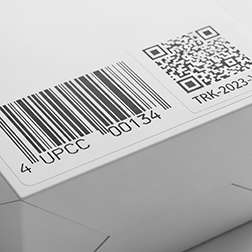
The format positioned for retail POS is a QR code built on the GS1 Digital Link standard. This is not the same as a marketing QR code that points to a brand homepage. A GS1 Digital Link QR code encodes a structured web URL that contains the GTIN and any additional data such as batch and expiration, and that URL can be configured to respond differently depending on what is scanning it. A retail POS scanner sees a price-lookup transaction. A consumer phone sees the brand-controlled landing page. A supply chain scanner sees traceability information. One code, multiple destinations, all controlled by a “resolver” that the brand owner manages.
How GS1 Digital Link Consolidates SmartLabel and Retail POS into One QR Code
SmartLabel, the consumer transparency initiative led by the Consumer Brands Association, has been deployed through a separate, dedicated QR code on packaging since 2017. Many CPG companies have made significant investment in SmartLabel content management, ingredient databases, and consumer-facing pages. GS1 Digital Link allows the SmartLabel destination, the retail POS scan, the recall traceability information, and brand-driven consumer engagement to live behind a single 2D code on the package.
The packaging real estate freed up by collapsing two QR codes and the legacy UPC into one is meaningful, but the bigger opportunity is unifying the consumer experience. Ingredients, allergens, sustainability disclosures, sourcing claims, recipe content, promotions, and post-purchase engagement can all be served from the same destination and updated dynamically without a packaging revision. A SmartLabel investment that has historically lived inside marketing and regulatory teams becomes a more strategic asset when it is connected to the primary product QR code. For brands that have already built out their SmartLabel content, the migration to GS1 Digital Link is more of an upgrade than a from-scratch rebuild.

The Inline Printing Challenge for 2D Barcodes on Primary Packaging
This is where many manufacturers run into real operational friction. A QR code requires significantly more print resolution and ink than a linear UPC, and each unit needs a unique QR code to enable unit-level traceability, which makes preprinted codes difficult. Primary packaging lines often run at 100 to 300 units per minute or higher, so a few practical realities are worth understanding before scoping a project.
Continuous inkjet (CIJ) and thermal inkjet (TIJ) printers can apply 2D codes inline at production speeds, but print quality on flexible films, glossy substrates, and curved surfaces requires careful testing. UV laser printers produce permanent codes but require multiple passes per dark module, which limits their use at the highest line speeds for fully variable codes. Inline verification has become standard practice because automation has replaced the operators who used to catch unreadable codes by eye, and a failed code that reaches a retailer can mean chargebacks.
Companies scoping a fully variable inline approach should plan for printer upgrades, vision systems, and operator training as a single project rather than three separate ones.
Case Labels: Where GS1-128 Stands and Why GS1 DataMatrix Is Coming Next
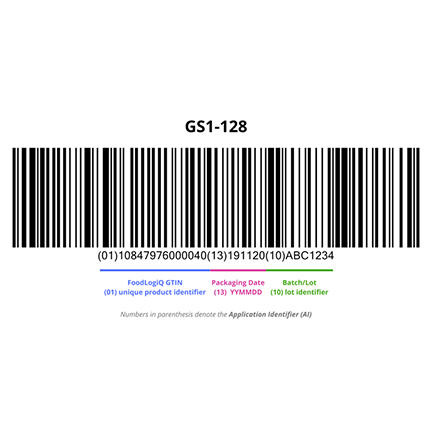
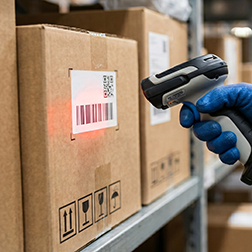
GS1-128 has been rolling out for case-level barcodes for years. It is a linear (1D) Code 128 barcode that uses GS1 Application Identifiers to encode the GTIN, batch, lot, weight, expiration date, and other logistics data on shipping cases and pallets. Its sunrise event happened a long time ago, but adoption inside many food and CPG companies has been slow and incremental, and a meaningful number of our members are still working through GS1-128 implementation today. The honest read of where the industry sits is that GS1-128 is the right place for most case-label projects to focus right now.
The proposed transition from GS1-128 to DataMatrix is the change that many of our members have not yet heard about, and it deserves to be on the radar even though the timeline is far less aggressive than the consumer side.
GS1 DataMatrix is the 2D successor to GS1-128, and it is the next change on the horizon for manufacturers. It uses the same GS1 Application Identifier data structure, which means the underlying data and the business logic carry over directly. The differences are physical and operational. DataMatrix is significantly more compact than the equivalent GS1-128 symbol, scans correctly in any orientation rather than requiring a clean horizontal pass, and recovers data from damaged or partially obscured codes through built-in error correction. It is already the dominant case-level code in healthcare and pharmaceutical supply chains and is well established in markets where compact size and durability matter.
The reason to be aware of DataMatrix now, even though most food retailers have not yet asked for it on cases, is that the labeling software, ERP integrations, and printer hardware being selected for current GS1-128 projects will determine how much rework is required when DataMatrix demand eventually arrives. The practical advice for most members is to finish the GS1-128 implementation that is in flight today, but to confirm with your labeling software vendor and your coding equipment partner that the toolchain you are buying can also generate compliant GS1 DataMatrix when the time comes. That single conversation, scheduled into the current project, can save a year of rework later.
Practical First Steps for CPG Manufacturers
For consumer packaging, three actions are reasonable. Audit the QR codes already on your SKUs to identify which are GS1 Digital Link compliant and which are marketing-only. Bring your packaging supplier and your coding equipment vendor into the same conversation, because the question of where each piece of the code gets printed affects both partners. Plan the data architecture for dynamic content, including who owns the resolver and who controls the destinations.
For case labels, the priority is finishing the GS1-128 work that is already in flight inside many of our member companies. The forward-looking step is confirming that the labeling software, ERP integrations, and printer hardware being selected today will also support GS1 DataMatrix when retailer demand materializes.
We are working to bring GS1 in as a speaker later this year so members can dig into both conversations directly. In the meantime, the resources below offer the most credible technical guidance I have found, and they are largely free of vendor sales pitches.
Resources for GS1 Sunrise 2027, GS1-128, and GS1 DataMatrix Implementation
For consumer packaging and Sunrise 2027:
- GS1 US Sunrise 2027 Overview: the official US program page with timelines, scanner readiness tracker, and implementation guidance
- GS1 2D Barcodes at Retail Point-of-Sale Implementation Guideline: the most comprehensive technical guide for retail POS implementation
- GS1 Digital Link Implementation Guideline (Global Edition): the technical reference for URI structure, resolvers, and link types
- GS1 FAQ on 2D Barcode Options: a clean comparison of the three approved 2D barcode formats
For case labels, GS1-128, and GS1 DataMatrix:
- GS1 DataMatrix Guideline: the official technical guide for DataMatrix, including its relationship to GS1-128 and the use of Application Identifiers
- Microsoft Learn: GS1 Barcodes Reference: a vendor-neutral technical explanation of Application Identifiers, FNC1 and GS separator handling, and encoding examples that apply to both GS1-128 and GS1 DataMatrix
Engaging Discussions Enable Confident Decisions®
When you’re busy with the daily demands of your job, it’s easy to overlook the opportunities that will drive long-term growth. When you become a member of a Drive Wheel peer group, you can identify new strategies, reduce risk, and make confident decisions that will grow your business faster and more strategically.
We host two-day in-person meetings twice a year where leaders discuss their new strategies, innovation plans, and business challenges to get feedback from their peers. Members leave the meeting knowing they have thought about their idea from every angle. Between meetings, we conduct benchmarking studies and weekly news roundups to keep our members informed about changes in the industry.